|
In early July, the real work began when we both
began work as staff for USAFA’s two-part Basic Cadet
Training (BCT). We job shadowed USAFA cadet staff
with different Flights (appx 40 cadets) during 1st
BCT, a garrison phase of training during which the
‘basics’ learn rudimentary military skills and
military knowledge. We began actual work as staff
during 2nd BCT, the field portion of the
course, where the basics live in a tent city and
complete a series of one-day courses. As CF members
working on the BCT program, we were able to gain an
appreciation for US style organization and
leadership, essential when learning to work with our
American counterparts. As we integrated ourselves
into their operation, we were able to gain the
respect of our American peers and superiors through
both our technical skills, such as weapons handling,
and the application of our Canadian perspective
through junior leadership.
The start of the school year saw us attending our
first classes and our real introduction to life at
USAFA. Both Ben and I took bar positions in our
squadrons, “Mighty Mach One” Cadet Squadron 1 and
“Proud Chickenhawks” Cadet Squadron 16. We plunged
headfirst into a world of form ups, football,
accountability sheets, taps and ‘lights on – doors
open’ when male and female cadets were in the same
room. Needless to say, it took both of us some time
to orient ourselves to our new surroundings. Later
in the year, we both completed a basic freefall
parachuting qualification at the USAFA drop zone,
which was a high point of the exchange.
After a great deal of reflection upon our return to
Canada, Ben and I realized that the countless
differences between USAFA and RMC could be
attributed to two main factors: scale and
visibility. USAFA is simply too big, in terms of
personnel, infrastructure and missions, to run as
RMC does. As well, USAFA is subject to far more
public exposure, both good and bad, than is RMC, and
must therefore play by a different set of rules than
we do.
Overall, the RMC-USAFA exchange was a great
experience, one that left us with two main lessons.
First, RMC cadets have nothing to complain about.
Although I personally would not have believed it in
May 2005, we at
the College are members of an organization where the
leadership can place emphasis on the individual,
and, due to the CF’s size and commitments, can and
must push us harder intellectually, |
academically and professionally as cadets. Second,
it is immature, myopic and unhealthy for Canadians
to look at our relations with the US, both civil and
military, through the prism of ‘us vs. them.’ All
told, there are things that we do better than them,
and there are things that they do better than us.
Both Ben and I saw this in spades during our time at
USAFA. The aim on both sides should be to understand
each other’s ways and capabilities and how,
together, they can best be put to use– something
that the RMC-USAFA Exchange is intended to foster.
As far as Ben and I are concerned, our exchange did
just that.
Alan Lockerby
23709
OCdt IV
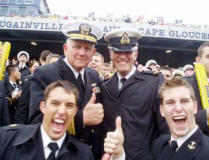
Attending the Army
/ Navy football game was part
of the cultural exchange
It was on the Friday 12th of August that
NCdt JME Isabelle and OCdt MCV St-Amant arrived at
the United States Naval Academy in Annapolis,
Maryland. The exchange started with a week of
traveling, visiting and learning more about the
different branches of the US Navy. The navy base of
Norfolk in Virginia, the Pentagon in Washington, the
Marine Corps Base and the Marine Corps Air facility
in Quantico welcomed us. There was about 40 cadets
on exchange at USNA for the semester, coming from
West Point, USAFA, Coast Guard, the French Academies
of Navy and Army, and of course, RMC. Bonds of
friendship that would last beyond the exchange
period were quickly made between the cadets.
Click Here for more on the Annapolis exchange
experience.
Appuyez ici
pour en savoir plus sur l’expérience d’être en
échange à Annapolis.
|